How to Change a Tyre Without Calling Roadside Assistance
Date: 05 January 2026
Whether driving on the challenging Indian roads, operating in the harsh mines, or in tough farming terrains, drivers must know how to change a tyre.
Why? Well, flat tyres and roadside failures don’t come with precautions. These challenges face you when you least expect them.
But the good news is you can fix them on your own, with a few handy tools, and most importantly, the skills. While you must have the tools with you at all times, we can help with the fixing part.
We’ll walk you through the process with guided steps like a roadside assistant. So, don’t worry.
Before you start: Safety First
Tyre failures can happen anywhere. But, before you start with a flat tyre repair, move to a safer space.
- Get to a safe, flat spot. A parking lot or a straight, well‑lit shoulder is best. Switch on hazard lights, keep the car in park (or first gear for manual), and set the parking brake. Put wheel chocks (or bricks/rocks) diagonally opposite the flat tyre so the car doesn’t roll.
- Find your tools. You’ll need the spare, jack, and lug wrench. Most cars store these in the boot floor; your owner’s manual shows exact jack points.
Quick tip for Indian roads: if the shoulder of the tyre is soft or hot (summer asphalt), place a sturdy wooden board under the jack so it doesn’t sink.
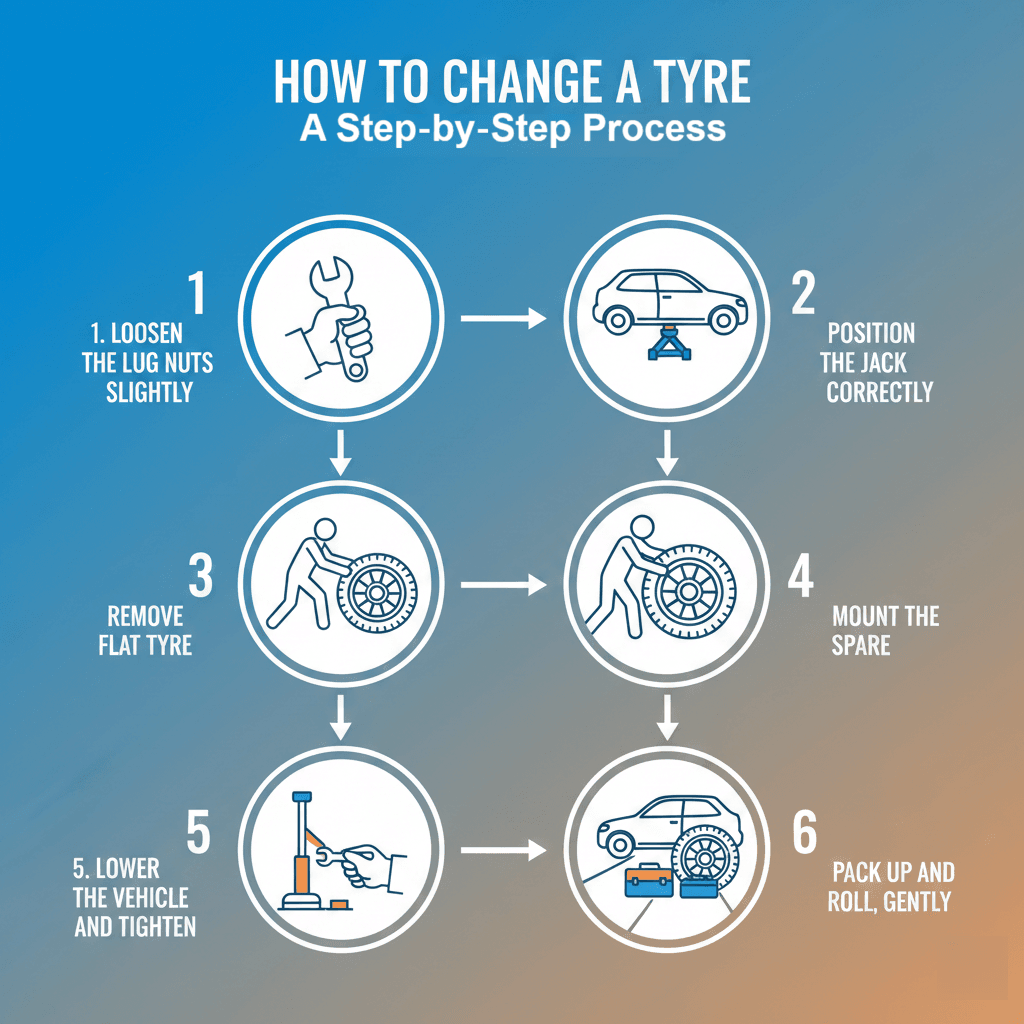
How to Change a Tyre? A Step‑by‑Step Process
Here is the step-by-step process for changing tyres without asking for help:
Step 1: Loosen the Lug Nuts Slightly
First, you have to focus on loosening the lug nuts. Do it while the wheel’s still on the ground. Remember not to remove them and simply loosen them first. The quarter turn is fine. If a nut is stubborn, slip a short metal pipe over the wrench handle for extra leverage. Always turn counter‑clockwise.
Step 2: Position the Jack Correctly
Check your manual for the exact jack point near the flat tyre. After that, place the jack squarely and raise the vehicle until the tyre is clear of the ground. No need to rush; stay calm and lift slowly.
[NB: Never put any part of your body under the vehicle when it’s supported only by a jack.]
Step 3: Remove the Flat Tyre
This is the stage to change flat tyres. Start by taking off the loosened nuts and sliding the wheel straight toward you. Next, keep the nuts in a small tray or pocket. Be careful and don’t lose them. (Some folks place the flat under the sill as a precaution.)
Step 4: Mount the Spare
How to change a tyre after removing the old ones? Once you’ve removed the old tyre, put aside the nuts in a safe place where you can find them.
It’s time to align the new tyre by lining up the holes. Push the spare onto the studs, and hand‑tighten the nuts. Tighten in a star (criss‑cross) pattern so the wheel seats evenly. Check what type of spare your car has! For instance, a full-size, space saver, or inflator kit? The steps differ slightly, and inflator kits don’t require jacking.
Step 5: Lower the Vehicle and Finally Tighten
Finally, lower the vehicle until the tyre just touches the ground, then tighten the nuts firmly in the star pattern with the wrench. Additionally, keep your feet clear and roll the wheel slightly away once it’s off to avoid strain or injury. If you have a torque wrench, use it to finish; correct torque protects brake discs and hubs. Typical passenger cars require 90–120 Nm, but always follow your owner’s manual (If you can’t do either, visit a tyre shop soon to have the torque checked.)
Step 6: Pack up and Roll, Gently
Stow your tools and the flat. Remember, most temporary spares (“donuts”) have speed and distance limits, commonly around ≤50 mph and about 50 miles, which is enough to reach a tyre shop. However, remember that even after fixing the tyre on your vehicle, you’ll need the wheel looked at by a professional. So, drive cautiously till you reach a tyre shop.
Advice on uneven roads: Avoid changing tyres on a curved or sloping road—even if it’s wide—due to rollover risk.
Disclaimer: If you feel unsafe, lack proper tools, or the ground is unstable, seek professional roadside assistance. Safety always comes first.
Little Things That Make a Big Difference
- Check the spare’s pressure at the next fuel pump; spares lose air over time.
- If you’re doing a seasonal swap (say, monsoon/winter), label the tyres (LF/RF/LR/RR) with chalk when removing them. Helps with future rotation and spotting uneven wear.
- Keep gloves and a garbage bag in the boot, for muddy tyres, and a torch for night work.
If your vehicle uses a bus bias tyre, make sure your spare matches the same size and load rating.
Common Mistakes to Avoid
- Loosening lugs after jacking: do it before you lift, or the wheel may spin and fight you.
- Wrong jack point: always follow the manual; incorrect placement can damage the body or suspension.
- Skipping the star pattern: tightening around the circle can misseat the wheel. Use the criss‑cross.
- Ignoring spare limits: donuts are temporary. Respect speed/distance.
Discipline is Key to Safety
At Birla, we prioritize discipline. The process of changing a tyre isn’t simply about taking your vehicle out of a difficult situation; it’s a process involving different stages. It’s a process with direct impact on the casing, hub, and brakes. So, if you do it right, your vehicle stays reliable.
However, in the long run, vehicle owners must do the small things right. This includes maintaining proper torque, balanced tightening, and cautious driving.
Also, you don’t always have to rely on assistance for others, for instance, tyre removals and changes. Especially, if you have to do it on the operating grounds like mines or farms. Stay focused and follow the tyre change guide shared through this article.